
One of the aims of our crime writing initiative is to support efforts to attract people from outside the area to attend events and include them in short breaks and holidays. To that end, it is well worth visiting the excellent www. tripfiction.com website, which allows readers to track down books by searching for favourite places rather than favourite authors.
Here, Tina Hartas, of Trip Fiction, pictured in Rome reading Early One Morning by Virginia Baily, which is set in the city, explains the changing global and UK trends in Literary Tourism and below her piece we explain the way that crime writers have used the Kirkcudbright and wider Dumfries and Galloway landscape in their work.
By Tina Hartas of TripFiction
Literary Tourism is certainly gaining traction. People are searching for new and different angles when it comes to planning trips, and exploring a location through literature is proving increasingly seductive.
Since the Covid pandemic, there has been a huge surge in interest in novels that are strong on location, offering a unique view into life and culture of any given place through the eyes of an author. At that point in the early 2020s, when people were unable to travel, books were one source of escape, and the notion of travelling by book was a chance to experience wanderlust from the confines of home.
Underlining the power of a novel’s strong setting, Stanfords in London – THE travellers’ choice of books store for maps and books – runs an annual award which shines a light on novels with a well-developed location, coupled with a good storyline (The Edward Stanford Travel Writing Awards – Fiction With a Sense of Place).
Originally, the three novels that had a seismic impact on the TripFiction founders, discovering engagement with location through a good story, were: the iconic The
Beach by Alex Garland (Ko Phi Phi, Thailand), Memoirs of a Geisha by Arthur Golden (Kyoto, Japan) and Shantaram by Gregory David Roberts (Mumbai, India). The evocation of locale in this trio remained strong in the memory and motivated the founders to seek out further novels that had a terrific sense of locale. The TripFiction website was born.
The power of the written word can inspire readers to visit the place about which they have read, and there are innumerable companies that facilitate a trip to many a literary setting. Readers who have been stimulated by a specific book or series can follow in the footsteps of Ian Rankin’s Rebus on organised tours in Edinburgh; Naples beckons for those who love Elena Ferrante; and Carol Ruis Zafón’s Shadow of the Wind makes a great basis for exploration of Barcelona. Before the pandemic, two planeloads of tourists arrived each day in Sicily to connect with Andrea Camilleri’s beloved protagonist Inspector Montalbano (although The Sunday Times highlighted that the tourists often ended up on the East side of the island where the TV adaptation of the books took place, rather than the West side where the novels were actually set).
There is, of course, much debate about whether an author should visit the setting of their proposed book, and there is much to be said on a personal level for imbibing the smells, the feel and the sounds that accost travellers. However, the internet also provides many options for a writer looking to connect with place, seeking to understand its unique qualities. The proof, of course, is whether readers feel transported to a particular place and can dive into the setting with gusto. An authentic feel is certainly a difficult element to capture and authors like David Hewson, Victoria Hislop, Louise Penny, Zadie Smith, Chimamanda Ngozi Adichie, Amy Tan and Barbara Nadel all capture the essence of the places they portray.
At TripFiction, we monitor the places around the world that prove particularly popular among readers. AuraPrint recently undertook an analysis, scouring the Google Books archive, and analysing more than 25 million works to uncover the thirty most written-about European cities between 1920 and 2019, revealing the key locations that have most inspired the literary imagination over the past century. The top four cities cited were London, Paris, Rome and Berlin. Writers may choose their setting, the publishers may guide their authors in terms of which locations draw readers in, but just because a location features multiple times in books across a century, does not guarantee a reading audience.
From our own limited research, the European locations that really fuel readers to devour books with a well-crafted sense of place are, indeed, London and Paris, but Venice and Edinburgh are very strong contenders for third and fourth place, whereas Rome and Berlin, in our experience, sadly don’t seem to fire up readers in the same way. Reykjavik is up there, too, as Icelandic Noir continues to be a popular choice for readers. Thus, authors need to be very brave to veer off course, choosing somewhere perhaps like Ljubljana, the Isle of Scilly or Phoenix – all great and transportive locations in their own right, but lacking the clout of certain big cities. Locations beyond Europe that prove exciting to the reading public are places like New York and India.
Immersion into place through literature is a wonderful way to gain greater understanding. Picking up a novel before a trip makes for great anticipatory preparation (a reader might even find some top tips for their visit). Reading whilst in the chosen location adds a sensory element, a 3-D experience, and then, upon return, a book can help reconnect with personal memories. Reading literature with a strong sense of place is a great way to ‘travel’.
How Literary Tourism is also having an impact at home
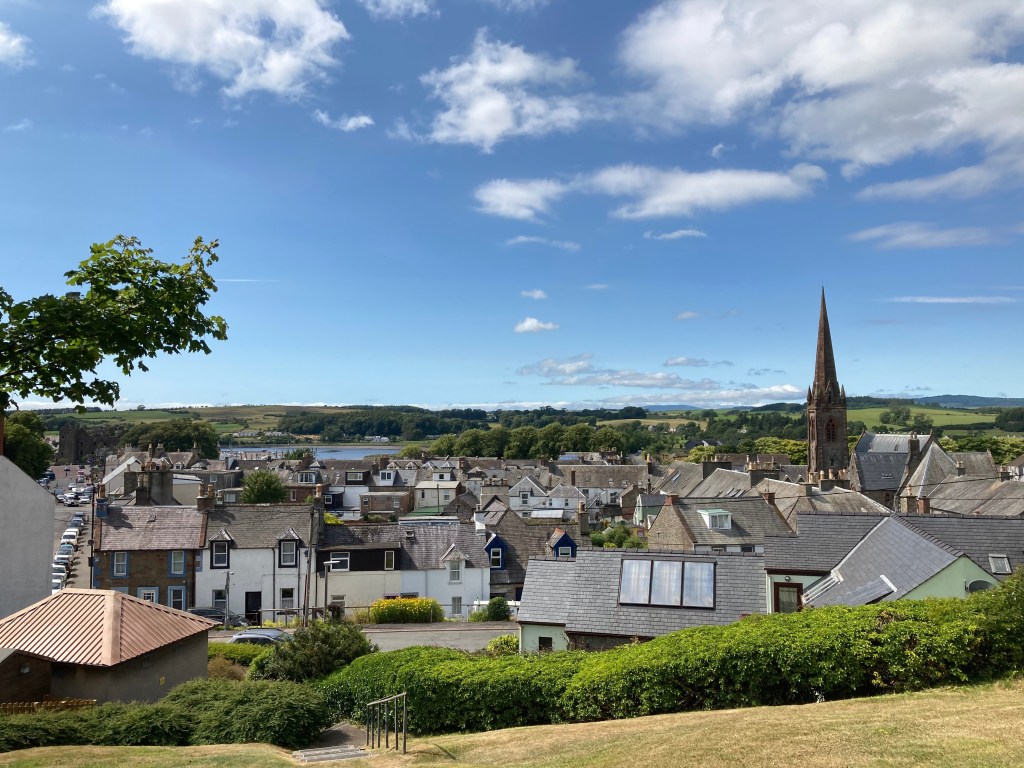
Literary tourism does not just take readers to well-known places. One of the many UK areas to benefit is Dumfries and Galloway, in South West Scotland, whose splendid landscape is used by all sorts of authors as settings for their work in a range of genres. The result has been more visitors and there is a definite trend towards people booking holidays and short breaks throughout the year, including for the area’s three annual literary festivals – Kirkcudbright Book Festival, Big Lit and Wigtown Book Festival.
It all started with Five Red Herrings, written by legendary crime author Dorothy L Sayers, which sees her famous investigator Lord Peter Wimsey’s fishing holiday interrupted when he investigates the murder of a local artist in Kirkcudbright. The novel, which was published in 1931 and is still available in ebook and hardcopy formats, begins with the death of Sandy Campbell, a drunkard loathed for his boorish behaviour, whose body is found at the bottom of a steep hill. Given that his easel is at the top of the hill, townsfolk assume that he fell while painting but Lord Peter disagrees and his suspicion is strengthened by the fact that six people hated the victim enough to become murder suspects. The novel, which tells how the gentleman sleuth clears five of the suspects and reveals the sixth as one of the most ingenious murderers he has faced, continues to be regarded as a classic of the genre.
Dumfries and Galloway has continued to inspire crime writers ever since, including Aline Templeton, one of Scotland’s most celebrated crime writers, who sets her DI Marjory Fleming series in Dumfries and Galloway in a mixture of real and fictional settings.
Another crime writer drawing heavily on the area is Lynne McEwan, whose popular series of novels featuring DI Shona Oliver are set in Dumfries and Galloway, and equally popular fellow crime writer Jackie Baldwin uses the area for some of her novels, including a number which have been based in the Dumfries legal sector.
John Dean’s DCI Jack Harris novels have as their primary location the English North Pennines but more recent novels have included real locations in southern Scotland, including a gangster’s fictional house on the hills overlooking the very real westbound A75 between Dumfries and Castle Douglas, and a fictional wildfowl rescue centre in the Ayrshire Hills.
Kirkcudbright picture used courtesy of John Smith


Leave a Reply