By Joan Fallon
The other day I was delighted to see that Dumfries and Galloway has a thriving literary community and couldn’t resist getting in touch with this website’s adminstrator John Dean to tell him that I, too, am a Dumfries and Galloway crime writer.
I was born in Dumfries and brought up in Annan for the first few years of my life, before my parents moved to England seeking work. In those days it was not as easy as it is now to keep in touch with relatives even when they were only a few hundred miles away. We had no telephone, it was long before the development of the internet and we had no car. So for many years, apart from an occasional holiday by train to see my granny Fallon, we were out of touch with the family. My mother was the eldest child of eight, so there were plenty of uncles, aunts and cousins that I could have got to know but that had to wait until later.
After several years working in England as a teacher, my husband and I moved to Spain to take advantage of an early-retirement opportunity and one of the first things I decided to do was to trace my family tree. I found that I could trace the ancestry of the Fallon family back to the 18th century.
I concentrated on my mother’s side of the family which was the Scottish connection despite the fact that she had an Irish surname, Fallon. Even as a child I found it amusing that my father was from Dublin and his surname was Scott, my mother was from Annan and her’s was Fallon. There had obviously been a few liaisons between the Scots and the Irish over the years and I soon found one of them when I started to investigate our family tree.
Michael Fallon from Sligo in the north-west of Ireland was a ship’s captain and in 1841 married a woman in Dumfries called Helen Scott. So already in the 19th century the Fallon surname was connected to Dumfries. I think my mother must have been concerned that we didn’t lose the Fallon name and when I was born I was duly christened Joan Fallon (after my grandmother) Scott.
If any of you crime writers have attempted a family tree you will realise that it is full of mysteries, unanswered questions and surprises; not unlike a crime novel. One Australian woman contacted me because a relative of hers, a John Martin, had emigrated to Australia in 1885 and she had found a link to the Fallon family. It did cross my mind as to whether it was emigration or deportation that had taken him to Australia but when I checked it seemed that the last convict ship arrived in Western Australia in 1868. Phew!
Probably the most gratifying part of constructing a family tree is getting to know the current family members, and with the new technology I was able to make contact with lots of them, some in Edinburgh, Liverpool, the New Forest and even in Australia, not forgetting Annan, of course.
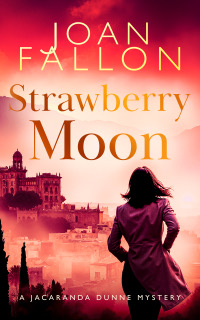
I am very proud of my Scottish blood, and whenever someone in Spain refers to me as English, I am quick to correct them. In 2006 I began to write professionally, starting with some contemporary women’s fiction but mostly historical fiction set in Andalusia. Then I began to write a series of crime novels. My husband loved reading crime fiction and tried to encourage me to start writing it. So after he died, I decided I would at least write one in his memory. That led to the Jacaranda Dunne Mysteries, featuring a Scottish/Spanish female private detective living in Málaga. I am now just starting book six in the series, which should be out by Christmas at the latest.
You can find out more at www.joanfallonbooks.com
Jacaranda DUNNE, Private Investigator
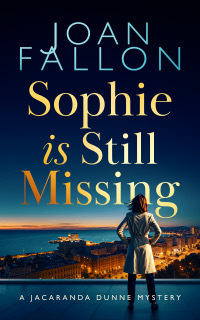
Book One: SOPHIE IS STILL MISSING
My main protagonist, Jacaranda Dunne, is approaching forty. She is tough, realistic, manipulative and brave, but she has a vulnerable side to her as well. While she was serving as a detective sergeant in the Metropolitan Police, her husband, also a serving officer in the Met, was stabbed and killed in a mugging outside the police station. She is haunted by the idea that it was her fault, and that her pursuit and arrest of Thomas Steed, a notorious drug dealer, was behind her husband’s death. She abandons her career and moves to Spain to open a small detective agency in Málaga.
Jacaranda, known as JD to her friends, is the oldest daughter of a Scottish father and a Spanish mother. Although she doesn’t like it to be generally known, her mother is the Marquesa of Calderón del Bosque, in southern Spain, and one day Jacaranda will inherit the title. Despite her Spanish blood, Jacaranda is blonde and fair skinned like her father. She has inherited his careful eye for detail and his passion for golf, but she also has her mother’s rebellious streak, and fondness for good wine. She refuses to drive a car, preferring to walk or take the metro.
Jacaranda has two staff, Ignacio, known as Nacho, a young Spaniard who manages the technical side of the agency—and not always strictly within the law—and Linda, her general assistant, a tall, brash Mancunian who has lived in Spain for many years, and has made many useful contacts. Together they make a good, balanced team.
As for Jacaranda’s love life, it’s five years since Jacaranda was widowed, and although she has had a number of casual relationships since then, she doesn’t want a permanent relationship with anyone. Until she meets a captain in the Guardia Civil, that is. But even then she feels she can’t move on until she has found out who killed her husband.
You can find out more at www.joanfallonbooks.com


Leave a comment